Hours worked over 40 in a workweek must be paid at not less than one and one-half times the regular rate. Source: U.S. Department of Labor, Wage and Hour Division, Overtime Pay (dol.gov/agencies/whd/overtime), read 2026-10-23.
Work out which hours count as overtime
Put in the hours you worked this week, the weekly threshold that applies where you are, and the multiplier. The split and the pay appear as you type. The numbers you type are not uploaded.
Results
Overtime hours
0:00
hours : minutes over the threshold
Regular hours
0:00
at the regular rate
Total hours
0:00
this workweek
Regular pay
$0.00
Overtime pay
$0.00
Estimated gross
$0.00
How this is worked out
—
About this calculator
This page answers one question: how many hours in a single workweek sit above the threshold, and what those hours pay. It takes a weekly total, a threshold and a multiplier, and it never sees your daily breakdown, your unpaid break minutes or your pay stubs. When hours arrive as clock-in and clock-out times, get the weekly total from the time card calculator first, then bring it back here.
Shared constants
Averaging of hours over two or more weeks is not permitted. Source: U.S. Department of Labor, Wage and Hour Division, Overtime Pay (dol.gov/agencies/whd/overtime), read 2026-10-23.
In California, work past 8 hours in a day or past 40 in a week pays at least 1.5x the regular rate; work past 12 in a day pays at least 2x; the first 8 hours on a seventh consecutive day pay 1.5x, and hours beyond that pay 2x. Source: California Labor Code §510(a), Stats. 1999 Ch. 134, effective 2000-01-01 (leginfo.legislature.ca.gov).
Where to start
Open the Overtime Calculator first: splitting one workweek into regular and overtime hours at a threshold you set is the step every other page in this group assumes you have already done. Move to the multiplier pages after that, and only when your week crosses a 12-hour or seventh-day line.
The rules this calculator uses — stated up front
Most overtime calculators hide their assumptions. If the number disagrees with your payslip, you have no way to tell why. These are the four decisions this page makes, and the ones it cannot make for you.
1 One workweek, never averaged
Overtime is counted inside a single workweek — a fixed, regularly recurring 168 hours, seven consecutive 24-hour periods. It does not have to match the calendar week.
Federal law does not permit averaging hours over two or more weeks. A 30-hour week followed by a 50-hour week is 80 hours of straight time, not 40 regular plus 40 overtime. This page follows that rule — enter one week at a time.
2 Weekly threshold, weekly multiplier
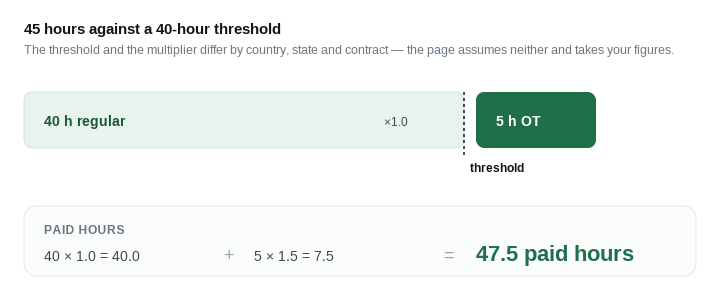
The default here is the federal rule: hours worked in excess of 40 in a workweek, paid at not less than time and one-half the regular rate. Both figures are editable, because your state or contract can differ.
Example 46 h at $20/h, threshold 40, ×1.5 → 40 h regular ($800.00) + 6 h overtime ($180.00) = $980.00
3 What it counts as hours worked
Enter hours actually worked, already net of unpaid breaks. Paid time off, holidays and sick days are not hours worked and do not push you over the threshold.
The overtime premium applies to the overtime hours only — 40 regular hours are never paid at the multiplied rate. Exempt employees, salaried workers who meet the duties test, and some industries have their own rules that this page does not model.
4 What this calculator cannot do
It works on weekly hours, so it cannot apply a daily overtime rule. California pays 1.5× over 8 hours in a workday and double time over 12, plus a seventh-consecutive-day rule; Alaska and Nevada also have daily rules; Colorado has a daily rule at a higher threshold. If your state works that way, you need your daily hours, not your weekly total.
It also cannot handle two or more different rates in one week (a weighted average is required), shift differentials, commissions, piece rates, or overtime that a contract sets above the legal minimum. It is a calculator, not payroll advice.
This page runs entirely in your browser. The numbers you type are not uploaded, no account is needed, and no numbers are stored anywhere but this tab. Reloading clears them. See the privacy policy for what that means in detail.
Overtime calculator questions
How is overtime calculated?
Take the hours worked in one workweek above the threshold, and pay them at the regular rate multiplied by the multiplier. Everything at or below the threshold is regular time. The federal default is hours over 40 at 1.5×; this page lets you change both the threshold and the multiplier to match your state or contract.
Is overtime after 8 hours a day or 40 hours a week?
Federally, 40 hours a week. A handful of states add a daily rule — California, Alaska, Nevada and Colorado — under which hours over a daily threshold are also overtime. This calculator uses weekly hours only and cannot apply a daily rule; if you are in one of those states, work from your daily hours instead.
Can I average my hours over two weeks?
No. Federal law does not permit averaging hours over two or more workweeks to avoid overtime. Each workweek stands alone.
Is the overtime rate paid on all my hours, or just the extra ones?
Just the extra ones. The first 40 hours are paid at your regular rate; only the hours above the threshold get the multiplier. If your rate is $20 and you work 46 hours, you are not paid 46 × $30 — you are paid 40 × $20 plus 6 × $30.
Does holiday or sick pay count towards the 40 hours?
No. Those are not hours worked. Only hours you were actually working count towards the threshold.
Does this handle two jobs or two pay rates in one week?
No. Where a single workweek covers two different straight-time rates, the regular rate for that week is the weighted average of those rates, and this page takes one rate. Enter the weighted average only if you have worked it out yourself — otherwise treat the result as an estimate.
Do I still need the time card calculator?
If your input is daily start and end times rather than a weekly total, the time card calculator turns those into hours first — then bring the total back here for the overtime split.
Related Calculators
HourlyCalcHub — weekly hours from daily start and end times
Get your weekly total in hh:mm and decimal hours first, then split it into regular and overtime here. It also has its own optional overtime row if you would rather do both on one page.
About this site — the rules, the funding and who runs it
What HourlyCalcHub is, why each calculator states its assumptions, and how the site is paid for. No account and no sign-up anywhere.
Double time and a half calculator — the 2.5× tier that sits above 1.5× and 2×
Federal law stops at 1.5×, so a 2.5× rate is almost always contractual. Page shows the arithmetic, when the 2.5× tier actually applies, and how to stack the three premium tiers in one shift.